Proof and Real Analysis
UBC Economics Math Camps
Logic and Proof Techniques
Mathematical Statements
Definition — Statement (Proposition)
A statement is a declarative sentence that is either true or false, but not both.
Statements:
- “It is raining.” (true or false)
- \(2 + 2 = 4\) (true)
- \(\sqrt{2} \in \mathbb{Q}\) (false)
Not statements:
- \(x > 0\) (depends on \(x\))
- “Is this true?” (a question)
Quantifiers
Much of mathematics involves “For all…” or “There exists…” — written \(\forall\) and \(\exists\).
Logical Connectives and Truth Tables
Let \(P =\) “It is raining” and \(Q =\) “It is cold.”
| \(P\) | \(Q\) | \(\neg P\) | \(P \wedge Q\) | \(P \vee Q\) | \(P \Rightarrow Q\) | \(\neg Q \Rightarrow \neg P\) |
|---|---|---|---|---|---|---|
| T | T | F | T | T | T | T\(^{\dagger}\) |
| T | F | F | F | T | F | F |
| F | T | T | F | T | T\(^{\dagger}\) | T\(^{\dagger}\) |
| F | F | T | F | F | T\(^{\dagger}\) | T |
- \(\neg P\): negation; \(\;P \wedge Q\): conjunction; \(\;P \vee Q\): disjunction
- Entries marked \(\dagger\) are vacuously true: \(P \Rightarrow Q\) is vacuous when \(P\) is false (rows 3–4); \(\neg Q \Rightarrow \neg P\) is vacuous when \(Q\) is true (rows 1, 3)
- The two implication columns are identical in every row — \(P \Rightarrow Q \equiv \neg Q \Rightarrow \neg P\)
Implication: \(P \Rightarrow Q\)
Vocabulary
In \(P \Rightarrow Q\), \(P\) is the hypothesis and \(Q\) is the conclusion.
With \(P =\) “It is raining,” \(Q =\) “It is cold”:
- Original \(P \Rightarrow Q\): “If it is raining, then it is cold.”
- Contrapositive \(\neg Q \Rightarrow \neg P\): “If it is not cold, then it is not raining.” (equivalent)
- Converse \(Q \Rightarrow P\): “If it is cold, then it is raining.” (not equivalent)
A common mistake: \(P \not\Rightarrow Q\) is not the same as \(P \Rightarrow \neg Q\)
- \(P \not\Rightarrow Q\): “It is not the case that raining implies cold” — the link fails somewhere
- \(P \Rightarrow \neg Q\): “If it is raining, then it is not cold” — a positive claim in the other direction
What Does It Mean to Prove \(P \Rightarrow Q\)?
Proving \(P \Rightarrow Q\) means: assuming \(P\) is true, we can never be in row 2.
| \(P\) | \(Q\) | \(P \Rightarrow Q\) | |
|---|---|---|---|
| T | T | T | \(\leftarrow\) Direct proof: show we always land here |
| T | F | F | \(\leftarrow\) must rule this out |
| F | T | T | (vacuously true) |
| F | F | T | (vacuously true) |
Three logically distinct ways to rule out row 2:
- Show \(P\) true always forces \(Q\) true — direct
- Prove the equivalent \(\neg Q \Rightarrow \neg P\) — contrapositive
- Assume \(P\) true and \(Q\) false, derive a contradiction — contradiction
Three Proof Strategies for \(P \Rightarrow Q\)
Direct Proof — stay in row 1
Assume \(P\) is true. Derive \(Q\) by a chain of valid steps.
Example: “It is raining \(\Rightarrow\) the ground is wet \(\Rightarrow\) it is slippery \(\Rightarrow\) …”
Proof by Contrapositive — prove \(\neg Q \Rightarrow \neg P\)
Assume \(Q\) is false. Derive \(P\) is false.
Example: “It is not cold \(\Rightarrow\) it is not raining.”
Proof by Contradiction — row 2 leads to a falsehood
Assume \(P\) true and \(Q\) false. Derive a logical impossibility.
Example: “Suppose it is raining but not cold. Then [contradiction].”
Quantified Statements and Implications
Key observation
Universal statements and implications are two sides of the same coin.
\(\forall\) Statement
“Any day that is raining is cold.”
Being cold is a property shared by all rainy days.
Implication Statement
“If it is raining, then it is cold.”
Being cold is true whenever it is raining is true.
Proving \(P \Rightarrow Q\) is always equivalent to showing that \(Q\) holds for every instance where \(P\) holds.
Biconditionals
Definition — Biconditional
\(P \Leftrightarrow Q\) (“\(P\) if and only if \(Q\)”, abbreviated iff) means: \[P \Rightarrow Q \quad \text{and} \quad Q \Rightarrow P.\]
Proof strategy
Prove both directions separately. Label them \((\Rightarrow)\) and \((\Leftarrow)\) clearly, and apply whichever technique suits each direction.
Notation reminder
- “\(P\) only if \(Q\)” means \(P \Rightarrow Q\)
- “\(P\) if \(Q\)” means \(Q \Rightarrow P\)
- “\(P\) if and only if \(Q\)” combines both
Set Theory
Sets and Basic Operations
Definition — Set
A set is a collection of distinct objects, called elements. We write \(x \in A\) if \(x\) belongs to \(A\), and \(A \subseteq B\) if every element of \(A\) is in \(B\).
Operations:
- \(A \cup B = \{x : x \in A \text{ or } x \in B\}\)
- \(A \cap B = \{x : x \in A \text{ and } x \in B\}\)
- \(A \setminus B = \{x : x \in A,\; x \notin B\}\)
- \(A^c = \{x \in X : x \notin A\}\)
De Morgan’s Laws: \[ (A \cup B)^c = A^c \cap B^c \] \[ (A \cap B)^c = A^c \cup B^c \]
Definition — Open Ball
The open ball of radius \(\varepsilon\) centred at \(x \in {\mathbb{R}}^n\): \[B(x,\varepsilon) = \{y \in {\mathbb{R}}^n : \|y - x\| < \varepsilon\}\]
Open and Closed Sets
Definition — Open Set
\(U \subseteq {\mathbb{R}}^n\) is open if \(\forall\, x \in U\), \(\exists\, \varepsilon > 0\) such that \(B(x, \varepsilon) \subseteq U\).
Definition — Closed Set
\(F \subseteq {\mathbb{R}}^n\) is closed if its complement \(F^c\) is open.
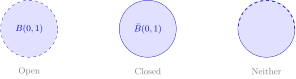
“Not open” \(\neq\) “closed.” \(\quad\) \({\mathbb{R}}^n\) and \(\emptyset\) are both open and closed.
Properties of Open and Closed Sets
Open sets are preserved under…
- Arbitrary unions
- Finite intersections
Warning: infinite intersections can fail. \[\bigcap_{n=1}^\infty \left(-\tfrac{1}{n},\tfrac{1}{n}\right) = \{0\}\] is closed.
Closed sets are preserved under…
- Arbitrary intersections
- Finite unions
Warning: infinite unions can fail. \[\bigcup_{n=1}^\infty \left[\tfrac{1}{n},1\right] = (0,1]\] is not closed.
The Real Line: Intervals and Completeness
Intervals in \({\mathbb{R}}\):
- \((a,b)\) — open
- \([a,b]\) — closed
- \([a,b)\), \((a,b]\) — neither
Balls in \({\mathbb{R}}^n\):
- \(B(x,r) = \{y : \|y-x\| < r\}\) — open
- \(\bar{B}(x,r) = \{y : \|y-x\| \le r\}\) — closed
Definition — Supremum / Infimum
Let \(A \subseteq {\mathbb{R}}\) be non-empty.
\(\sup A\) = least upper bound of \(A\).
\(\inf A\) = greatest lower bound of \(A\).
Completeness Axiom
Every non-empty \(A \subseteq {\mathbb{R}}\) bounded above has a supremum in \({\mathbb{R}}\).
Bounded and Compact Sets
Definition — Bounded Set
\(A \subseteq {\mathbb{R}}^n\) is bounded if \(\exists\, M > 0\) such that \(\|x\| \le M\) for all \(x \in A\).
Definition — Compact Set (in \(\R^n\))
\(K \subseteq {\mathbb{R}}^n\) is compact if it is both closed and bounded.
Example
- \([0,1]^n\) is compact.
- \((0,1)\) is not compact — it is not closed.
- \({\mathbb{R}}\) is not compact — it is not bounded.
- The budget set \(\{x \ge 0 : p \cdot x \le w\}\) is compact.
Sequences and Limits
Sequences
Definition — Sequence
A sequence in \({\mathbb{R}}^n\) is a function \({\mathbb{N}}\to {\mathbb{R}}^n\). We write \((x_k)_{k=1}^\infty\) or \((x_k)\).
Definition — Convergence
\((x_k)\) converges to \(L \in {\mathbb{R}}^n\), written \(x_k \to L\), if: \[\forall\, \varepsilon > 0,\quad \exists\, K \in {\mathbb{N}}\text{ such that } k \ge K \;\Rightarrow\; \|x_k - L\| < \varepsilon.\]
Proposition — Uniqueness of Limits
If \((x_k)\) converges, its limit is unique.
Properties of Convergent Sequences
Let \((x_k) \to x\) and \((y_k) \to y\) in \({\mathbb{R}}\).
Algebraic Limit Theorem
- \(x_k + y_k \to x + y\)
- \(c\,x_k \to cx\)
- \(x_k y_k \to xy\)
- \(x_k / y_k \to x/y\) (provided \(y \neq 0\), \(y_k \neq 0\))
Order Limit Theorem
If \(x_k \le y_k\) for all \(k\), then \(x \le y\).
Squeeze Theorem
If \(x_k \le z_k \le y_k\) for all \(k\) and \(x_k, y_k \to L\), then \(z_k \to L\).
Monotone Sequences
Definition — Monotone Sequence
\((x_k)\) is non-decreasing if \(x_k \le x_{k+1}\) for all \(k\), and non-increasing if \(x_k \ge x_{k+1}\) for all \(k\).
Theorem — Monotone Convergence Theorem
Every bounded monotone sequence in \({\mathbb{R}}\) converges.
- If \((x_k)\) is non-decreasing and bounded above, then \(x_k \to \sup_k x_k\).
- If \((x_k)\) is non-increasing and bounded below, then \(x_k \to \inf_k x_k\).
Example
\(x_k = 1 - \tfrac{1}{k}\) is non-decreasing and bounded above by \(1\), so it converges. Indeed \(x_k \to 1 = \sup_k x_k\).
Limit Points and Closed Sets
Definition — Limit Point
\(x \in {\mathbb{R}}^n\) is a limit point of \(A \subseteq {\mathbb{R}}^n\) if there exists a sequence \((x_k)\) in \(A\) with \(x_k \neq x\) for all \(k\) and \(x_k \to x\).
Theorem — Sequential characterisation of closed sets
\(F \subseteq {\mathbb{R}}^n\) is closed \(\iff\) \(F\) contains all its limit points:
\((x_k) \subseteq F\) and \(x_k \to x \;\Rightarrow\; x \in F\).
Example
- \([0,1]\): any convergent sequence in \([0,1]\) has its limit in \([0,1]\). Closed.
- \((0,1)\): \(x_k = \tfrac{1}{k} \in (0,1)\) but \(x_k \to 0 \notin (0,1)\). Not closed.
Subsequences and Accumulation Points
Definition — Subsequence
A subsequence of \((x_k)\) is \((x_{k_j})\) where \(k_1 < k_2 < k_3 < \cdots\).
Proposition
If \(x_k \to L\), then every subsequence converges to \(L\).
Definition — Accumulation Point
\(L\) is an accumulation point of \((x_k)\) if some subsequence converges to \(L\).
Theorem — Bolzano–Weierstrass
Every bounded sequence in \({\mathbb{R}}^n\) has a convergent subsequence.
Functions and Continuity
Functions
Definition — Function
A function \(f : X \to Y\) assigns to each \(x \in X\) exactly one \(f(x) \in Y\).
- \(X\): domain; \(\quad Y\): codomain
- Range: \(f(X) = \{f(x) : x \in X\} \subseteq Y\)
Preimage
For \(B \subseteq Y\): \[f^{-1}(B) = \{x \in X : f(x) \in B\}\]
Preimage identities
\[\begin{align} f^{-1}(A \cup B) &= f^{-1}(A) \cup f^{-1}(B)\\ f^{-1}(A \cap B) &= f^{-1}(A) \cap f^{-1}(B)\\ f^{-1}(A^c) &= (f^{-1}(A))^c \end{align}\]
Continuity
Definition — \(\varepsilon\)-\(\delta\) (pointwise)
\(f : X \to {\mathbb{R}}^m\) is continuous at \(x_0\) if: \[\forall\, \varepsilon > 0,\quad \exists\, \delta > 0: \quad \|x - x_0\| < \delta \;\Rightarrow\; \|f(x) - f(x_0)\| < \varepsilon.\]
Sequential characterisation (equivalent)
\(f\) is continuous at \(x_0\) if and only if: \[x_k \to x_0 \;\implies\; f(x_k) \to f(x_0).\]
Topological characterisation (equivalent)
\(f\) is continuous on \(X\) if and only if \(f^{-1}(V)\) is open for every open \(V \subseteq {\mathbb{R}}^m\).
Algebra of Continuous Functions
Proposition
If \(f, g : X \to {\mathbb{R}}\) are continuous at \(x_0\), then so are:
- \(f + g\), \(\quad cf\) (any constant \(c\)), \(\quad fg\)
- \(f/g\) provided \(g(x_0) \neq 0\)
Proposition — Composition
If \(f : X \to Y\) and \(g : Y \to Z\) are continuous, then \(g \circ f\) is continuous.
Example
Polynomials are continuous everywhere. Rational functions are continuous wherever the denominator is non-zero.
Key Theorems
Theorem — Extreme Value Theorem
Let \(f : K \to {\mathbb{R}}\) be continuous with \(K \subseteq {\mathbb{R}}^n\) compact. Then \(f\) attains its maximum and minimum on \(K\): \[\exists\; x^*, x_* \in K: \quad f(x_*) \le f(x) \le f(x^*) \quad \forall\, x \in K.\]
Theorem — Intermediate Value Theorem
Let \(f : [a,b] \to {\mathbb{R}}\) be continuous. If \(y\) lies between \(f(a)\) and \(f(b)\), then \(\exists\, c \in (a,b)\) with \(f(c) = y\).
EVT in economics: the budget set \(B(p,w)\) is compact and utility is continuous, so a utility maximiser always exists.
Summary
Summary
Logic & Proofs
- Statements, quantifiers, connectives
- \(\forall x,\, P(x)\) as an implication
- Contrapositive \(\equiv\) original; converse \(\not\equiv\)
- Direct / contrapositive / contradiction
- Biconditionals: prove both directions
Set Theory
- Operations, De Morgan’s laws
- Open / closed sets and properties
- Compact \(=\) closed \(+\) bounded
Sequences
- \(\varepsilon\)-\(K\) definition of convergence
- Algebraic, order, squeeze theorems
- Bounded monotone \(\Rightarrow\) converges
- Closed sets contain all limit points
- Bolzano–Weierstrass
Functions & Continuity
- Three equivalent characterisations
- Algebra of continuous functions
- Extreme Value Theorem
- Intermediate Value Theorem