import os
os.environ["USE_TF"] = "0"                             #transformers: use torch only, skip TensorFlow
os.environ["HF_HUB_DISABLE_SYMLINKS_WARNING"] = "1"    #disable a Windows-only cache warning
import sqlite3
import duckdb
import numpy as np
import pandas as pd
import torch
from transformers import AutoTokenizer, AutoModel
from sklearn.decomposition import PCA
import matplotlib.pyplot as plt

pd.set_option("display.max_colwidth", 100) #show more of each text column, needed for cell output readabilityDatabases for AI: Embeddings and Vector Search
Python
SQL
data engineering
The tenth notebook in the Data Engineering stream. We now examine a table of consumer-complaint narratives and SQL fails at a simple request: find the ones about debt collectors harassing people. We turn text into embeddings, search by meaning with ORDER BY, and choose the right grain for long documents.
Outline
Prerequisites
- Notebook 9 of this stream: the pipeline that loads and validates every new data batch.
Learning Outcomes
By the end of this notebook you will be able to:
- Explain why keyword search fails on meaning (synonyms, phrasing, negation), and name situations where it succeeds.
- Turn text into embeddings, and interpret cosine similarity.
- Run vector search and filtered vector search in SQL against the warehouse.
- Justify a chunking grain with retrieval evidence when documents are long.
1. Where we are in the stream
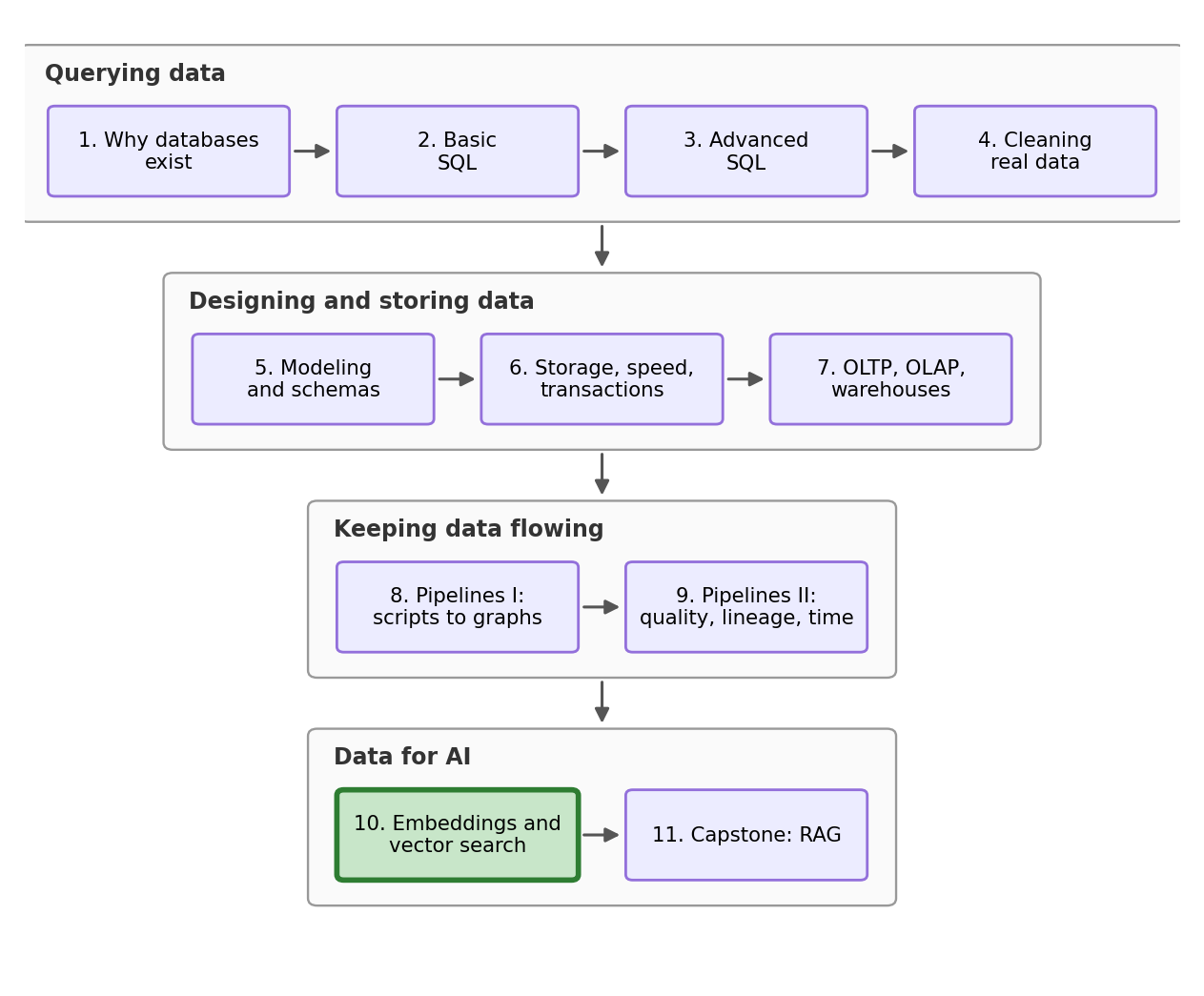
A new arc begins here. Nine notebooks gave us a warehouse filled with data we can trust, updated daily by a pipeline that clearly validates its own work. This notebook is about what happened when different data appears: real text, from real people.
The request, Tuesday 1:55 p.m. “For the household-debt study we pulled 390 published complaint narratives from the CFPB, the American consumer-protection agency. We want to know what borrowers actually face from debt collectors: find the complaints where people describe collectors harassing them. This should take you an hour.”
It will not take an hour. By the end of section 3 you will watch every tool from Notebooks 2 through 9 fail at this request. First, every library the notebook needs, and some small config updates:
2. Text Data
For the first time in this stream nothing is simulated. The Consumer Financial Protection Bureau publishes complaints that American consumers file against financial companies. The CFPB also publishes their story in their own words, scrubbed of any personal information; every XXXX you see is that anonymization, blocking names, dates, and amounts. The database is in the public domain.
We pulled 390 of these stories from March 2023, drawn evenly from six complaint categories. Our target category is labelled Communication tactics: the debt-collection label that covers harassing calls. Consumers pick these labels themselves from a fixed menu when they file, which gives us a free answer key for this notebook. We will check how many of our results from different approaches land in the Communication tactics category.
complaints = pd.read_csv("datasets/cfpb_complaints.csv")

print("narratives:", len(complaints))
complaints["issue"].value_counts()
narratives: 390issue
Trouble during payment process 65
Dealing with your lender or servicer 65
Problem with a purchase shown on your statement 65
Incorrect information on your report 65
Communication tactics 65
Managing an account 65
Name: count, dtype: int64390 total narratives, 65 in each of six categories, including the 65 under Communication tactics. Here is what three of them look like - we print the first 250 characters of each:
for i in range(3):
    row = complaints.iloc[i]
    print(f"[{row['state']} | {row['issue']}]")
    print(row["narrative"][:250] + "...\n")
[SC | Trouble during payment process]
I made a {$5000.00} payment to the money source company. Before they transferred the mortgage to Mr Cooper. Now Mr Cooper will not acknowledge the {$5000.00} payment on their side. I have proof of payment from XXXX. Please help....
[TX | Dealing with your lender or servicer]
It is my belief, The Department of Education, MOHELA, XXXX, XXXX and XXXX d/b/a the UNITED STATES XXXX are all voluntarily , knowingly and intentionally, individually, and personally undeniable aware of criminal acts of mis-administration and malfeas...
[CO | Trouble during payment process]
We lost our home in a wildfire. This was a federally declared disaster. Cardinal Financial holds our Mortgage Loan. All insurance proceeds checks are made out to Cardinal Financial, as well as us. We have endorsed all checks and forwarded them to Car...
Each entry has the state that it comes from along with a deeper category label like “Trouble during payment process.” This is real text about experiences real Americans had; let’s dig deeper and search for harassment.
3. Keyword search is limited
Notebook 4 gave us a tool we can use here. The SQL command LIKE, where % matches any run of characters, so '%call%' matches “call” anywhere inside a narrative. In these stories harassment usually happens over the phone, so call is an obvious keyword for us to try. Another option is harass, but people often describe situations of harassment without explicitly using the word. We load the complaints into a scratch SQLite database and try it:
lite = sqlite3.connect(":memory:")
complaints.to_sql("complaint", lite, index=False)

print(pd.read_sql("SELECT COUNT(*) FROM complaint WHERE narrative LIKE '%call%'", lite).iloc[0, 0],
      "of 390 complaints mention 'call'")
pd.read_sql("""SELECT issue, COUNT(*) AS mentions_call FROM complaint
               WHERE narrative LIKE '%call%' GROUP BY issue ORDER BY issue""", lite)
163 of 390 complaints mention 'call'| issue | mentions_call | |
|---|---|---|
| 0 | Communication tactics | 51 |
| 1 | Dealing with your lender or servicer | 23 |
| 2 | Incorrect information on your report | 5 |
| 3 | Managing an account | 24 |
| 4 | Problem with a purchase shown on your statement | 32 |
| 5 | Trouble during payment process | 28 |
163 of 390, spread across all six categories. As a filter the word is worthless. Let’s look deeper at some of the 163 hits.
they_call = pd.read_sql("""SELECT narrative FROM complaint
    WHERE issue = 'Communication tactics' AND narrative LIKE '%calls me%'
    ORDER BY complaint_id LIMIT 1""", lite)
print("them calling:")
print(they_call.iloc[0]["narrative"][:250] + "...\n")

i_called = pd.read_sql("""SELECT narrative FROM complaint
    WHERE narrative LIKE '%I called%' AND issue != 'Communication tactics'
    ORDER BY complaint_id""", lite)
print("calling them:")
print(i_called.iloc[1]["narrative"][:250] + "...")
them calling:
Commenity Bank calls me numerous times a day under different numbers, as well as blocked numbers that show up as unknown and no caller ID. I explained my situation to them a few months ago, that I am unable to make a payment currently, but they conti...
calling them:
On XX/XX/2022, I wrote to Comenity Bank/Victoria Secret to dispute 2 late payments showing on my account. I advised them that I called member service when I got out of the hospital to file a claim with Account Assure as I would be unable to make my p...The keyword “call” is correctly mentioned in both, but the situations are polar opposites. In the first, the calls are the harassment: numerous times a day, from different numbers, from blocked numbers. In the second, the customer is the one calling, while trying to fix a billing dispute. LIKE sees the text string “call” and nothing more: not who is calling, not how often, not why. Meaning lives in context, and raw letters don’t carry contextual meaning.
The next logical idea we can try is dropping the generic word (call) and combining precise phrasings instead:
Predict first. Four patterns:
calls me,stop calling,keep calling,threaten. There are 65 Communication tactics complaints. How many will the new chain catch, and will everything it catches be one of them?
chain = pd.read_sql("""SELECT issue FROM complaint
                       WHERE narrative LIKE '%calls me%' OR narrative LIKE '%stop calling%'
                          OR narrative LIKE '%keep calling%' OR narrative LIKE '%threaten%'""", lite)
print(f"the chain catches {len(chain)} complaints")
chain["issue"].value_counts()
the chain catches 26 complaintsissue
Communication tactics 20
Trouble during payment process 3
Dealing with your lender or servicer 2
Problem with a purchase shown on your statement 1
Name: count, dtype: int6426 hits: 20 from our target category, and 6 from other categories. We improved our precision quite significantly, but two problems remain. First the strays; here is one, caught by threaten alone:
stray = pd.read_sql("""SELECT issue, narrative FROM complaint
                       WHERE narrative LIKE '%threaten%' AND issue != 'Communication tactics'
                       ORDER BY complaint_id LIMIT 1""", lite)
print(f"[{stray.iloc[0]['issue']}]")
print(stray.iloc[0]["narrative"][:250] + "...")
[Trouble during payment process]
Plaza Home Mortgage has threatened on two occasions, to charge me approximately {$380.00} for supposedly not having homeowners ' insurance from XX/XX/XXXX to XX/XX/XXXX. I've called this company a total of four times in an attempt to correct the issu...A mortgage company “threatened” a 380 dollar insurance charge. This is not the debt collector harassment we are looking for; there are no debt collectors or repeated calls. The bigger problem is everything the chain never sees:
missed = pd.read_sql("""SELECT narrative FROM complaint
    WHERE issue = 'Communication tactics'
      AND narrative NOT LIKE '%calls me%' AND narrative NOT LIKE '%stop calling%'
      AND narrative NOT LIKE '%keep calling%' AND narrative NOT LIKE '%threaten%'
    ORDER BY complaint_id""", lite)
print(f"{len(missed)} harassment complaints match none of the four patterns\n")
for i in range(3):
    print(missed.iloc[i]["narrative"][:250] + "...\n")
45 harassment complaints match none of the four patterns
XX/XX/23 - Received a phone call from XXXX asking to speak with XXXX XXXX. Informed person that they have the wrong number and that I've received multiple phone calls in the pass from this number asking to speak with the same person. I've explained I...
I've been contacted by this XXXX company about 20 times by completely different ( spoofed ) phone numbers. Each time I tell them I am not the person that they are looking for and to take me off their calling list. I recently got a string of SMS messa...
National Credit Systems , INC is operating with out a state license and not registration in South Carolina according to the XXXX consumer access report. They have added two collections on XXXX and XXXX and I would like them removed for this illegal t...
45 of the 65 harassment complaints slip through all four patterns. Read how people actually write: “I’ve received multiple phone calls in the pass from this number asking to speak with the same person”, “contacted by this XXXX company about 20 times by completely different ( spoofed ) phone numbers”. These are examples of the harassment we are looking for, but they are not written in the same way; we are running into synonym and phrasing failures. Every pattern we add fixes some previous misses, but at the same time creates new ones, and we could keep adding OR lines for a week without converging to all 65. This is simply a bad approach.
There is one more over-arching issue here: a complaint saying “the collector never calls me” would still match calls me, because matching characters cannot see a “never”. That is a negation failure. LIKE matches characters. Our task asked for a meaning. Let’s look at a popular way to derive that meaning.
4. Embeddings: coordinates of meaning
Embeddings
An embedding is a list of numbers that records where a piece of text sits in a space of meanings. A model trained on billions of sentences has learned which words tend to appear together, and it uses that experience to place every text at a point: texts about the same topic land close together, unrelated texts land far apart. When similar text lands together we can compute distance and similarity mathematically.
This all sounds quite abstract, and if you have not studied other natural language processing (NLP) techniques or linear algebra it may be unfamiliar. We will start with an example in two dimensions and build up from there.
A list of two numbers, like \((3, 4)\), is a vector: an arrow from the origin to that point in the plane. In the case of embeddings two arrows pointing the same direction mean they are similar, while two arrows at a right angle are completely unrelated. The standard measurement of “how much do two arrows agree” is cosine similarity, the cosine of the angle between them. Mathematically it is:
\[ \text{similarity}(a, b) \;=\; \cos(\theta) \;=\; \frac{a \cdot b}{\lVert a \rVert \, \lVert b \rVert} \]
At the top, the dot product \(a \cdot b\) multiplies coordinates from the same axis and then sums them. The length \(\lVert a \rVert\) is just how long the arrow is. The result is \(1\) when the arrows point the same way, \(0\) at a right angle, and \(-1\) when they point in opposite directions. So cosine similarity ranges from \(1\) to \(-1\), with \(1\) being identical and \(-1\) being opposite.
Let’s show this visually. The next cell builds three vectors: b points in a direction similar to a, and c sits at a right angle to it. The cosine function is the formula above in Python. We draw both comparisons side by side, with the computed similarity in each title:
a = np.array([3, 4])
b = np.array([4, 1])      #points in a similar direction to a
c = np.array([4, -3])     #at a right angle to a

def cosine(u, v):
    return u @ v / (np.linalg.norm(u) * np.linalg.norm(v))

fig, axes = plt.subplots(1, 2, figsize=(10, 5))
for ax, other, name in [(axes[0], b, "b"), (axes[1], c, "c")]:
    ax.arrow(0, 0, a[0], a[1], head_width=0.25, length_includes_head=True)
    ax.arrow(0, 0, other[0], other[1], head_width=0.25, length_includes_head=True)
    ax.text(a[0] + 0.3, a[1], "a")
    ax.text(other[0] + 0.3, other[1], name)
    ax.set_xlim(-1, 6)
    ax.set_ylim(-4.5, 5.5)
    ax.grid(True)
    ax.set_aspect("equal")
    ax.set_title(f"similarity(a, {name}) = {cosine(a, other):.2f}")
plt.show()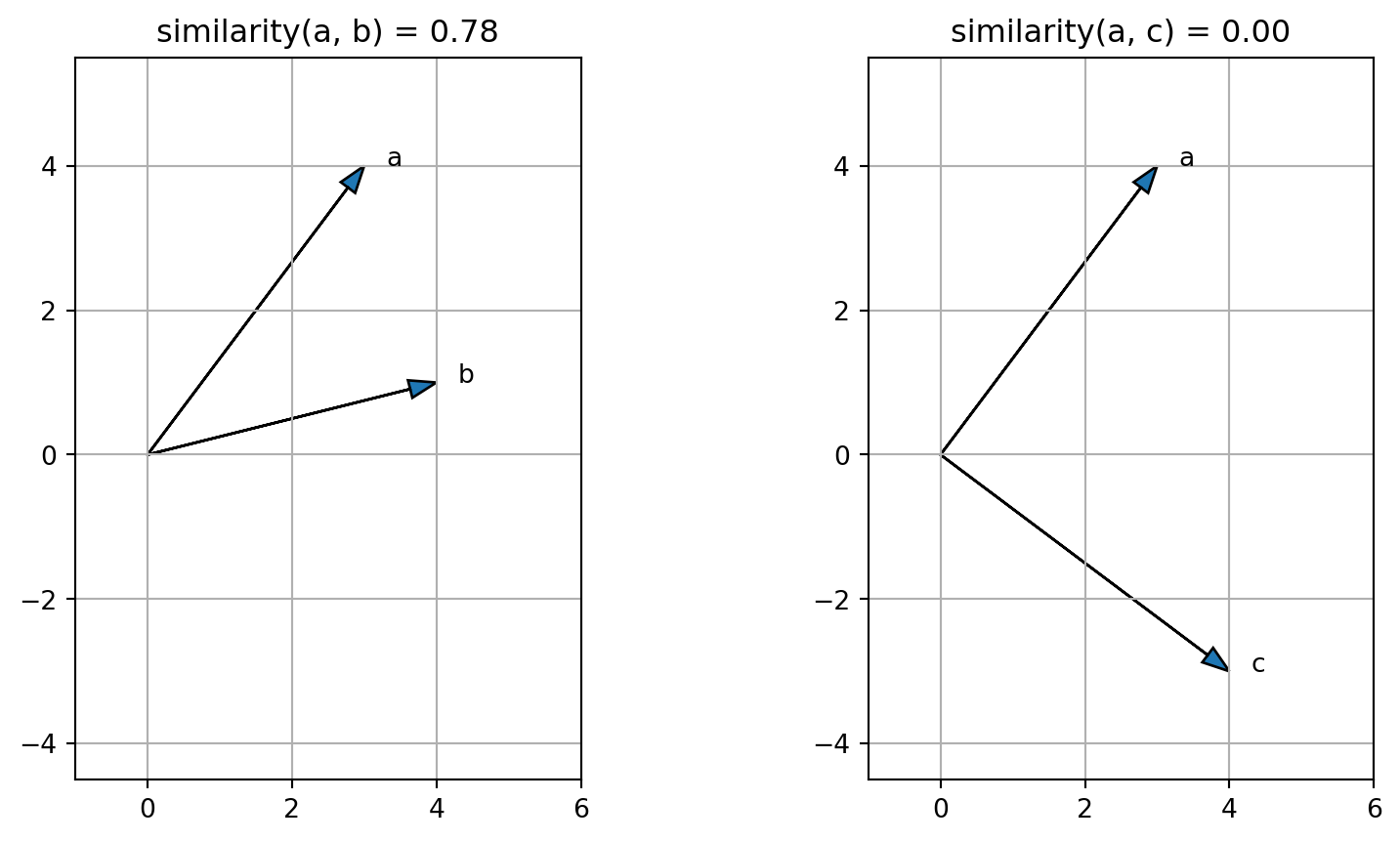
The vectors a and b are similar so they score a positive and high similarity (\(0.78\)); the right angle from a and c scores exactly 0. The lengths of the arrows never matter, only the angle between them.
Everything we just did in 2 dimensions works in any number of dimensions, 2, 200 or 2000. The model we use is all-MiniLM-L6-v2, a small, free, commonly used sentence-embedding model that maps any text to 384 dimensions. The initial download is about 90 MB; after that it loads from a local cache. If you want to go deeper into the NLP side of all this we have a prAxIs text embeddings workshop.
Let’s load the model.
tokenizer = AutoTokenizer.from_pretrained("sentence-transformers/all-MiniLM-L6-v2")
model = AutoModel.from_pretrained("sentence-transformers/all-MiniLM-L6-v2").eval()
The model hands back one vector per token, and we want one per text. A token is the small unit of text the model actually reads, produced by the model’s own tokenizer. Let’s look at how the tokenizer works on two example phrases: “The collector keeps calling about my debt” and “I called Comenity about my paycheque”.
print(tokenizer.tokenize("The collector keeps calling about my debt"))
print(tokenizer.tokenize("I called Comenity about my paycheque"))
['the', 'collector', 'keeps', 'calling', 'about', 'my', 'debt']
['i', 'called', 'come', '##nity', 'about', 'my', 'pay', '##che', '##que']The first sentence is seven everyday words, so it becomes seven tokens. These words already exist in the model’s training set so it just re-uses the ones it knows. In the second, the model has never seen the firm “Comenity” or the Canadian spelling of “paycheque”, so it builds them from pieces: “come” plus “##nity”, “pay” plus “##che” plus “##que”, where ## marks a fragment that continues the previous piece. Every token gets its own 384-number vector, which is why a sentence output is a bunch of values which together form its vector in 384-dimension space.
To get our embeddings we run four steps: tokenize the batch, run the model, average each text’s token vectors into one, then scale every vector to length one. We also explicitly never train this model, we just use it as is.
def embed(texts):
    encoded = tokenizer(texts, padding=True, truncation=True, return_tensors="pt")
    with torch.no_grad():
        output = model(**encoded)                                #one vector per token
    mask = encoded["attention_mask"].unsqueeze(-1)               #1 for real tokens, 0 for padding
    vectors = (output.last_hidden_state * mask).sum(1) / mask.sum(1)   #mean pooling
    vectors = vectors / vectors.norm(dim=1, keepdim=True)        #stretch to length one
    return vectors.numpy()

demo = embed(["The collector calls me five times a day", "They will not stop phoning me at all hours"]) #the sentences we compare in this demo cell
print("shape:", demo.shape)
print("first five numbers of the first vector:", np.round(demo[0, :5], 3))   #np.round trims the printout
print(f"similarity = {demo[0] @ demo[1]:.3f}")
shape: (2, 384)
first five numbers of the first vector: [-0.04 0.081 0.001 0.011 -0.093]
similarity = 0.341The first five values of our 384 dimension vector are \(-0.04, 0.081, 0.001, 0.011, -0.093\), and individually they mean nothing; only the whole direction of all 384 numbers does.
We can look at how different sentences compare, we will use “The collector calls me five times a day” as our baseline and contrast it to 4 other sentences and compute each one’s cosine similarity. You can read the other sentences in the cell code below.
#Comparison sentences below
pairs = [("The collector calls me five times a day", "They will not stop phoning me at all hours"),
         ("The collector calls me five times a day", "My credit report shows an account that is not mine"),
         ("The collector calls me five times a day", "My escrow analysis came back wrong this year"),
         ("The collector calls me five times a day", "The collector never calls me at all")]
rows = []
for a, b in pairs:
    va, vb = embed([a, b])
    rows.append({"sentence_b": b, "similarity": round(float(va @ vb), 3)})
pd.DataFrame(rows)| sentence_b | similarity | |
|---|---|---|
| 0 | They will not stop phoning me at all hours | 0.341 |
| 1 | My credit report shows an account that is not mine | 0.191 |
| 2 | My escrow analysis came back wrong this year | 0.144 |
| 3 | The collector never calls me at all | 0.754 |
The phone-call paraphrase is close (\(0.341\)), the credit-report complaint is more unrelated at \(0.191\), the escrow complaint furthest (\(0.144\)). What really matters for us is the ordering. Now look at the last row: this is the sentence with the exact opposite meaning and it scores a \(0.754\), the highest on the table.
If you expected a negative number, which represents arrows pointing exactly opposite ways, then you would be mistaken, as a negation is not an anti-topic. Embeddings measure topic, never truth or stance. Both sentences are precisely about a collector and calling, so their arrows are very similar. The model correctly identifies these as similar.
Now the whole text corpus. The narratives are long, so we embed them in batches of 64 and collect the results into one list. The warehouse then stores the vectors in a column next to the text. DuckDB has a column type for exactly this, a fixed-length array written FLOAT[384], and Notebook 9’s DESCRIBE confirms what we built:
texts = complaints["narrative"].tolist()               #.tolist turns the column into a plain list
vectors = []
for start in range(0, len(texts), 64):                 #count upwards in steps of 64
    vectors.extend(embed(texts[start:start + 64]))     #.extend appends the whole batch at once
complaints["embedding"] = [v.tolist() for v in vectors]

warehouse = duckdb.connect("datasets/wage_warehouse.duckdb")
warehouse.execute("""CREATE OR REPLACE TABLE complaint AS
    SELECT complaint_id, state, issue, narrative, CAST(embedding AS FLOAT[384]) AS embedding
    FROM complaints""")

warehouse.execute("DESCRIBE complaint").df()[["column_name", "column_type"]]| column_name | column_type | |
|---|---|---|
| 0 | complaint_id | BIGINT |
| 1 | state | VARCHAR |
| 2 | issue | VARCHAR |
| 3 | narrative | VARCHAR |
| 4 | embedding | FLOAT[384] |
The complaint table now holds text and coordinates in different columns. Before searching, let’s look at the space itself. 384 dimensions are impossible to visualize (and would be pretty meaningless anyway), so PCA (principal component analysis) pushes them down to the two directions with the most spread; distances survive the pressing only roughly, but clusters stay clearly visible:
flat = PCA(n_components=2, random_state=42).fit_transform(np.array(vectors))   #learn and apply the 2-D projection

plt.figure(figsize=(9, 6))
for issue in complaints["issue"].unique():
    inside = (complaints["issue"] == issue).to_numpy()                         #True/False mask for this category
    plt.scatter(flat[inside, 0], flat[inside, 1], label=issue, s=22, alpha=0.8)
plt.legend(fontsize=8)
plt.title("390 complaints, 384 dimensions, pressed onto 2")
plt.show()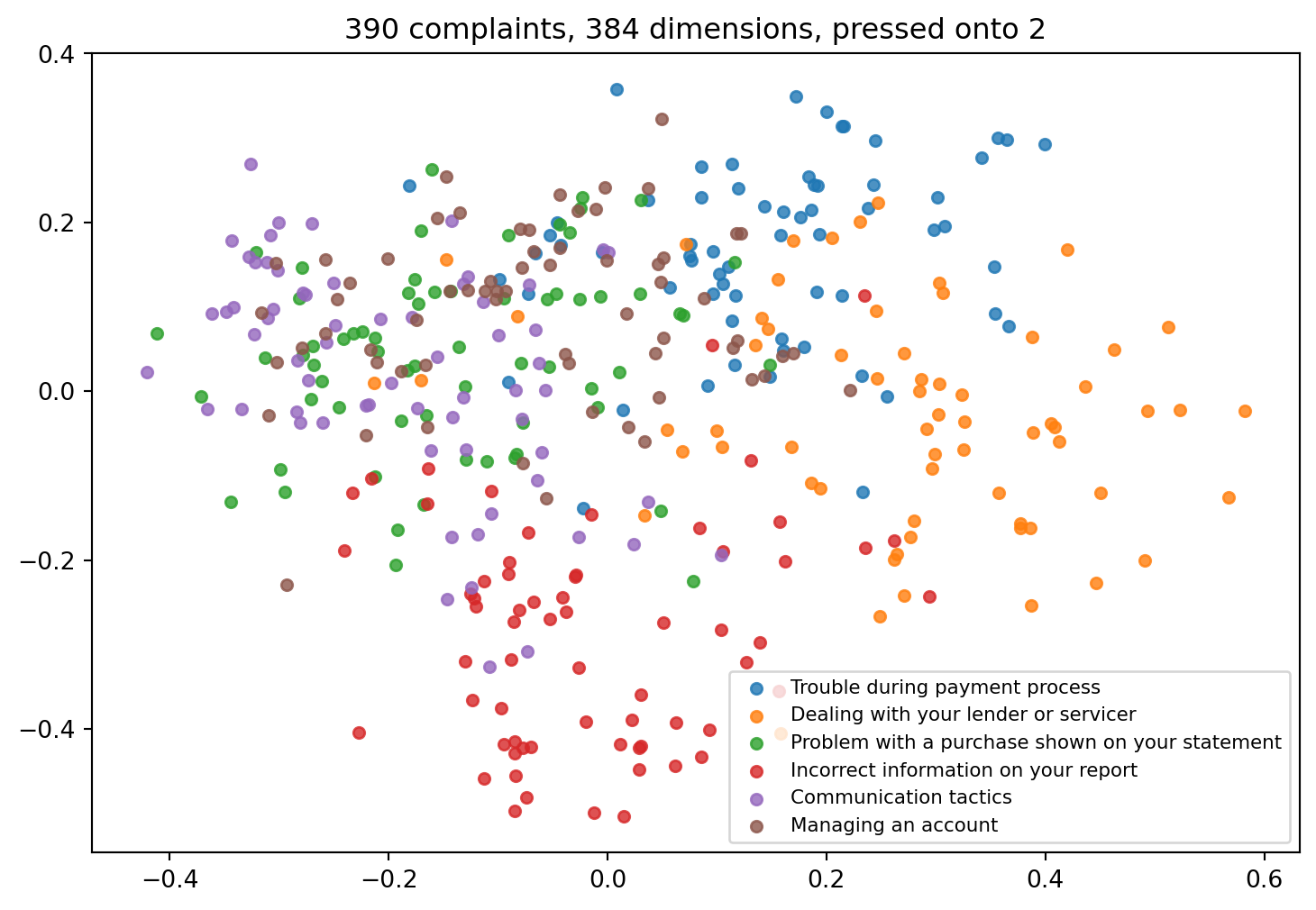
We can see some rough structure, even though it is messy. Mortgage and payment troubles drift to the upper right, student-loan complaints sit closer to the right edge, and the credit-report disputes cluster towards the bottom. The model never saw the CFPB’s labels, and still drew this structure on its own.
5. Vector search with ORDER BY
To search this space we don’t need any new tools. DuckDB’s array_cosine_distance computes one minus the cosine similarity from section 4, so 0 means identical direction and bigger means further apart. We wrap it in a helper function that shows the first 80 characters of each hit, and start with the literal word from the request “harassment”:
def search(query, k=5):
    qv = embed([query])[0].tolist()
    return warehouse.execute("""SELECT round(array_cosine_distance(embedding, CAST(? AS FLOAT[384])), 3) AS distance,
                                       issue, substr(narrative, 1, 80) AS start_of_narrative
                                FROM complaint ORDER BY distance LIMIT ?""", [qv, k]).df()

search("harassment")| distance | issue | start_of_narrative | |
|---|---|---|---|
| 0 | 0.459 | Dealing with your lender or servicer | XXXX, XXXX XXXX XXXX with Navient has contacted my employer and has attempted to |
| 1 | 0.560 | Communication tactics | Employees, at the XXXX TN location repeatedly use very aggressive and threating |
| 2 | 0.569 | Communication tactics | ON XXXX I saw a charge off on my credit report from company Caine & Weiner i cal |
| 3 | 0.571 | Communication tactics | XXXX or XXXX XXXX XXXX has now called me back to back within 2 seconds of each |
| 4 | 0.579 | Communication tactics | On Monday XX/XX/2023 at XXXX I began to receive repeated text messages from mult |
Four of the five issues in our output are from the Communication tactics label, this is already better, but let’s inspect the top result:
top_hit = warehouse.execute("""SELECT narrative FROM complaint
    ORDER BY array_cosine_distance(embedding, CAST(? AS FLOAT[384])) LIMIT 1""",
    [embed(["harassment"])[0].tolist()]).df()
print(top_hit.iloc[0]["narrative"][:400] + "...")
XXXX, XXXX XXXX XXXX with Navient has contacted my employer and has attempted to harass me and my employer. He wants my employer to call him and to send him personal information on me. In an attempt to get them to put pressure on me or possibly fire me. This tactic is unprofessional and unethical. Please stop Navient from using these bullying techniques on Alabama employers and employees.
Thank ...It is a student-loan complaint, filed under “Dealing with your lender or servicer”, about Navient contacting the writer’s employer. The consumer filed it under servicing; the model read the content, and saw it as a harassment story. The label and the model disagree, but in my opinion the model might be right; this could be classified as harassment. Regardless of your stance on this, a one-word query is a vague point in meaning space. Let’s do something else and phrase the query as “debt collectors harassing me with constant phone calls” which is far more detailed and carries greater meaning for the model than just “harassment”.
search("debt collectors harassing me with constant phone calls", 10)| distance | issue | start_of_narrative | |
|---|---|---|---|
| 0 | 0.247 | Communication tactics | XXXX XXXX, a debt collector keeps calling me multiple times a day every single d |
| 1 | 0.260 | Communication tactics | this is medical debt that my insurance lapsed on. ive never had a collection com |
| 2 | 0.291 | Communication tactics | THIS COMPANY CALLS EVERY SINGLE DAY 2-3X/DAY, AT ALL HOURS OF THE DAY. \nI HAVE R |
| 3 | 0.315 | Communication tactics | Portfolio recovery, a debt collector keeps calling me multiple times a day every |
| 4 | 0.318 | Communication tactics | Commenity Bank calls me numerous times a day under different numbers, as well as |
| 5 | 0.322 | Communication tactics | collector is desrespecful to my family members/XXXX XXXX was told of following t |
| 6 | 0.329 | Communication tactics | I've been getting several calls monthly to my cellphone now daily from Portfolio |
| 7 | 0.334 | Communication tactics | This company called me sometimes up to 5 times a day even though I had told them |
| 8 | 0.354 | Communication tactics | On XX/XX/XXXX, I received a call from MCM Midland Management LLC. I never author |
| 9 | 0.360 | Communication tactics | I called the number back because of constant calls and emails and The gentleman |
Ten out of ten from the target category, at distances 0.247 to 0.360. Read what the ranking found: “keeps calling me multiple times a day every single day”, “CALLS EVERY SINGLE DAY 2-3X/DAY, AT ALL HOURS”, “calls me numerous times a day under different numbers”. None of those rows contain the word “harass”. No keyword chain built this list, and none ever could. Meaning did, easily.
6. The scoreboard, and where keywords still win
The CFPB’s labels let us grade both search methods. The keyword chain caught 26 complaints, 20 of them actually in the target category. For vector search, count the labels deeper into the ranking:
qv = embed(["debt collectors harassing me with constant phone calls"])[0].tolist()

top20 = warehouse.execute("""SELECT issue, substr(narrative, 1, 80) AS start_of_narrative FROM complaint
    ORDER BY array_cosine_distance(embedding, CAST(? AS FLOAT[384])) LIMIT 20""", [qv]).df()
print(f"top 20 by distance: {(top20['issue'] == 'Communication tactics').sum()} carry the target label")
top20
top 20 by distance: 18 carry the target label| issue | start_of_narrative | |
|---|---|---|
| 0 | Communication tactics | XXXX XXXX, a debt collector keeps calling me multiple times a day every single d |
| 1 | Communication tactics | this is medical debt that my insurance lapsed on. ive never had a collection com |
| 2 | Communication tactics | THIS COMPANY CALLS EVERY SINGLE DAY 2-3X/DAY, AT ALL HOURS OF THE DAY. \nI HAVE R |
| 3 | Communication tactics | Portfolio recovery, a debt collector keeps calling me multiple times a day every |
| 4 | Communication tactics | Commenity Bank calls me numerous times a day under different numbers, as well as |
| 5 | Communication tactics | collector is desrespecful to my family members/XXXX XXXX was told of following t |
| 6 | Communication tactics | I've been getting several calls monthly to my cellphone now daily from Portfolio |
| 7 | Communication tactics | This company called me sometimes up to 5 times a day even though I had told them |
| 8 | Communication tactics | On XX/XX/XXXX, I received a call from MCM Midland Management LLC. I never author |
| 9 | Communication tactics | I called the number back because of constant calls and emails and The gentleman |
| 10 | Communication tactics | I informed the company when they called and told them Ive recently lost my job a |
| 11 | Communication tactics | Tower loan keeps calling every day 7 or more times a day. They are calling my hu |
| 12 | Problem with a purchase shown on your statement | Im being harassed by Victoria Secret. They are CONSTANTLY calling my phone all d |
| 13 | Communication tactics | ON XXXX I saw a charge off on my credit report from company Caine & Weiner i cal |
| 14 | Communication tactics | On Monday XX/XX/2023 at XXXX I began to receive repeated text messages from mult |
| 15 | Communication tactics | Midland Credit XXXX has consistently called me multiple times a week, including |
| 16 | Communication tactics | MCM or midland credit management has now called me back to back within 2 seconds |
| 17 | Dealing with your lender or servicer | I am being harassed by Navient, although I received approval for debt relief fro |
| 18 | Communication tactics | Comenity Bank repeatedly calls me up to 10-15 times a day for payment on my cred |
| 19 | Communication tactics | Hello, Ive been receiving none stop phone calls from this number with NO voicema |
18 of the top 20, from a single query written in plain language. We can read twenty complaints instead of the whole 390, and that is the whole point of retrieval. Imagine if instead of 390 we used the millions that the CFPB holds; we would never be able to read all of it.
This is already an excellent result, but vector search is not always the perfect tool for everything. Watch what happens when the query is an exact token instead of a meaning. Some complaints cite chapter and verse of debt-collection law, we will search for the FDCPA, statute 15 U.S.C. 1692, which is a law that protects consumers from abusive, deceptive, and unfair debt collection practices by third-party collection agencies.
This time we skip our search helper and write the query directly, with a CASE column (Notebook 2’s if-else statement) that labels which law each hit actually cites.
qv_law = embed(["section 1692 FDCPA violation"])[0].tolist()

warehouse.execute("""SELECT round(array_cosine_distance(embedding, CAST(? AS FLOAT[384])), 3) AS distance,
                            CASE WHEN narrative LIKE '%1692%' THEN 'cites 1692, the FDCPA'
                                 WHEN narrative LIKE '%1681%' THEN 'cites 1681, the FCRA'
                                 ELSE 'cites no statute' END AS law_cited,
                            substr(narrative, 1, 60) AS start_of_narrative
FROM complaint ORDER BY distance LIMIT 5""", [qv_law]).df()| distance | law_cited | start_of_narrative | |
|---|---|---|---|
| 0 | 0.559 | cites 1681, the FCRA | I am reporting an FCRA violation on my credit account with J |
| 1 | 0.566 | cites 1681, the FCRA | In accordance with the Fair Credit Reporting act XXXX Accou |
| 2 | 0.578 | cites 1681, the FCRA | In accordance with the Fair Credit Reporting act XXXX Accoun |
| 3 | 0.579 | cites no statute | In accordance with United States Codes and Federally protect |
| 4 | 0.589 | cites no statute | On XXXX XXXX 2023 XXXX was garnished from my Wells Fargo che |
Read the law_cited column top to bottom: three statements cite statute 1681, the Fair Credit Reporting Act, a different law, two cite no statute at all, and the complaints that actually cite 1692 appear nowhere in the top five. To a meaning model, legal boilerplate all looks alike, and digits carry almost no meaning. Now using Notebook 4’s tool.
pd.read_sql("""SELECT issue,
                      substr(narrative, MAX(instr(narrative, '1692') - 40, 1), 110) AS text_around_1692
FROM complaint WHERE narrative LIKE '%1692%'""", lite)| issue | text_around_1692 | |
|---|---|---|
| 0 | Communication tactics | tory remark which violates 15 U.S. Code 1692e - False or misleading representations ( 8 ) Commun... |
| 1 | Communication tactics | pal of this account. Pursuant to 15 USC 1692c ( c ) I am hereby ordering Convergent Outsourcing ... |
Exactly two complaints cite statute 1692, chapter and verse, and SQL’s normal LIKE returns just those two flawlessly. When we are looking for an exact name or value, keyword search is the correct tool. Real systems utilize a best of both worlds and run a filtered vector search: hard SQL filters for what must be exact (like our legal statute above), vector ranking for parts where meaning is valuable. In SQL they combine naturally. (Vector databases also sell a cousin of this idea under the name hybrid search, which fuses a keyword relevance score with the vector similarity score instead of filtering first.) Let’s look at harassment complaints, but only from Texas:
warehouse.execute("""SELECT state, round(array_cosine_distance(embedding, CAST(? AS FLOAT[384])), 3) AS distance,
                            substr(narrative, 1, 80) AS start_of_narrative
                     FROM complaint
                     WHERE state = 'TX'
ORDER BY distance LIMIT 3""", [qv]).df()| state | distance | start_of_narrative | |
|---|---|---|---|
| 0 | TX | 0.394 | Hello, Ive been receiving none stop phone calls from this number with NO voicema |
| 1 | TX | 0.423 | I was called frequently and when trying to get clarification on the issue, I was |
| 2 | TX | 0.440 | ON XXXX XXXX TOLD ME THEY WILL NOT CONTACT ME ANY MORE TO MY PHONE NUMBER XXXX. |
WHERE narrows to Texas exactly, the distance orders by meaning, and all three are collector-harassment stories. Exactly what we wanted to find.
7. Chunking is a grain decision
One design decision remains before this search is ready: what is one row? Notebook 2 named it the grain of a table. In retrieval the same question is called chunking: when documents are long, what unit do you embed, the whole document or its pieces? The grain determines what your retrieval system can find.
Our 390 narratives were short enough to embed whole. But the CFPB also receives long, multi-page complaints, and we downloaded three real ones alongside the sample. Each is several paragraphs long. We will search for one specific detail in one of the stories: the fraud cost the author refinancing, and student loans for their daughter’s education. We print the three complaints below along with id, and state. Our target is 6627407 which is the complaint for California.
longs = pd.read_csv("datasets/cfpb_long_complaints.csv")
longs["narrative"] = longs["narrative"].str.replace("\r", "")
print(longs[["complaint_id", "issue", "state"]])
print("lengths:", longs["narrative"].str.len().tolist())
complaint_id issue state
0 6627407 Attempts to collect debt not owed CA
1 6632901 False statements or representation NY
2 6636826 Attempts to collect debt not owed TX
lengths: [2220, 3162, 2510]We are back in plain numpy here, away from DuckDB’s distance column, so we score with cosine similarity itself: v @ question, bigger means closer, exactly like section 4. ascending=False sorts the table best-first.
Predict first. We embed each complaint as one full text-block and search for the education-loans detail. How well do we do?
doc_vectors = embed([t.replace("\n", " ") for t in longs["narrative"]])
question = embed(["the fraud made me unable to get student loans for my daughter"])[0]

longs["similarity"] = [round(float(v @ question), 3) for v in doc_vectors]
longs[["complaint_id", "issue", "similarity"]].sort_values("similarity", ascending=False)| complaint_id | issue | similarity | |
|---|---|---|---|
| 0 | 6627407 | Attempts to collect debt not owed | 0.452 |
| 1 | 6632901 | False statements or representation | 0.390 |
| 2 | 6636826 | Attempts to collect debt not owed | 0.364 |
The right complaint does score highest, at 0.452 against 0.390 and 0.364, but a margin of 0.06 is too small to blindly trust. The reason is dilution: one sentence about a daughter’s student loans was averaged together with multiple-pages of context, disputes, and lawyers. All three documents ended up making the same over-arching general point, “long identity-theft complaint”, so picking out a small detail becomes hard for our model at this grain. Now let’s split every complaint into paragraphs and embed those instead.
paragraphs = []
for cid, text in zip(longs["complaint_id"], longs["narrative"]):
    for number, para in enumerate(text.split("\n\n"), 1):
        if para.strip():
            paragraphs.append({"complaint_id": cid, "paragraph": number, "text": para.strip()})
para_df = pd.DataFrame(paragraphs)

para_vectors = embed(para_df["text"].tolist())
para_df["similarity"] = [round(float(v @ question), 3) for v in para_vectors]

print(para_df.sort_values("similarity", ascending=False).iloc[0]["text"])
para_df.sort_values("similarity", ascending=False).head(3)[["complaint_id", "paragraph", "similarity", "text"]]
In XXXX, I began receiving calls and letters from Persolve LLC demanding payment for this fraudulent debt. Despite providing proof that the debt was not mine, they refused to remove it from my credit report. As a result, I was denied refinancing for my home, student loans for my daughter 's education, and personal credit cards. As a XXXX of a company, I was also unable to obtain a corporate card or small business loan, despite our company 's earnings of over {>= $1,000,000} per year.| complaint_id | paragraph | similarity | text | |
|---|---|---|---|---|
| 2 | 6627407 | 3 | 0.614 | In XXXX, I began receiving calls and letters from Persolve LLC demanding payment for this fraudu... |
| 1 | 6627407 | 2 | 0.540 | In XXXX, my identity was stolen and several accounts were opened using my information, including... |
| 11 | 6636826 | 1 | 0.401 | In XX/XX/XXXX I was planning to buy a home, so I applied for a mortgage. My application was deni... |
The correct case wins at \(0.614\). Second place, at \(0.540\), is a neighbouring paragraph from the same complaint; the best paragraph from any other complaint is down at 0.401. The margin grew from \(0.06\) at document grain to \(0.21\) at paragraph grain, a more trustworthy gap. If we chunk too big then signals dilute; chunk too small (for example single words) and there is no meaning left to embed at all. Choosing that grain is a core design decision of every retrieval system you will ever build.
8. Conclusion
The request said this should take an hour. It took the whole notebook, but we finished! The single keyword matched 163 of 390 complaints and told us almost nothing. The four-pattern chain caught 20 of the 65 harassment stories and dragged in 6 unrelated entries. The embedding search got 18 of its top 20 right from one plain sentence, and even surfaced harassment stories that were filed under other labels. But it’s not perfect: it cannot read “never”, and it can’t find statute numbers that LIKE finds perfectly. So instead of choosing one we combine them: LIKE for details and embeddings for meaning.
The big idea to take away is that meaning itself can now live in a database. Once text becomes coordinates in space, searching by meaning is just ORDER BY distance LIMIT 5, and it works alongside every SQL tool from this stream. Still, nothing we built actually reads these complaints; ranking them is not the same as understanding them. Reading is a job for a language model, and plugging one into everything we have built, the schema, the pipeline, the validation, and now this search, is Notebook 11. One notebook left, and it puts the whole stream together! We will build a Retrieval-Augmented Generation (RAG) system, a framework that improves LLM accuracy significantly by grounding its responses.
Appendix: the landscape beyond tables
Storage follows the shape of the data, and because of that, every shape has grown its own product category:
| Shape of the data | Category | Names you will meet |
|---|---|---|
| rows and columns | relational | SQLite, DuckDB, PostgreSQL (Notebooks 1 to 9) |
| nested documents | document store | MongoDB, CouchDB |
| key and value, at speed | key-value store | Redis, Memcached |
| nodes and edges | graph database | Neo4j, Neptune (ex: Notebook 8’s DAGs could be stored here) |
| vectors | vector database | Pinecone, Chroma, pgvector, sqlite-vec, DuckDB’s vss extension |
For vectors specifically the boundary is dissolving: PostgreSQL can use vectors through pgvector, SQLite through sqlite-vec, DuckDB through its vss extension, so the “vector database” is increasingly just a column type in the database you already run. That is exactly how we used it in this notebook: a FLOAT[384] column in plain DuckDB.
Connections
- Back to Notebook 9: the pipeline happily loads and validates batches of text like this one, checking counts, nulls, and schema. No check we wrote could ever judge what the text means. We use embeddings to fix that gap.
- Forward to Notebook 11: the capstone. A language model finally joins us and reads what this notebook’s search retrieves, and everything underneath, schema, ETL, validation, lineage, becomes one complete system you build.
References
- Consumer Financial Protection Bureau. Consumer Complaint Database. https://www.consumerfinance.gov/data-research/consumer-complaints/ The source of every narrative in this notebook: public domain, published with consumer consent, scrubbed of identifying details (how the CFPB shares complaint data). Our 390-row sample comes from March 2023 across six issue categories.
- Reimers, N., & Gurevych, I. (2019). Sentence-BERT: Sentence Embeddings using Siamese BERT-Networks. EMNLP 2019. The paper behind the sentence-transformers family our model comes from.
- Hugging Face model card. sentence-transformers/all-MiniLM-L6-v2. https://huggingface.co/sentence-transformers/all-MiniLM-L6-v2 The exact model, its training recipe, and the mean-pooling code section 4 adapts.
- DuckDB documentation. Array functions and the vss extension. https://duckdb.org/docs/stable/sql/functions/array and https://duckdb.org/docs/stable/core_extensions/vss
array_cosine_distanceand friends, plus the HNSW index for when corpora outgrow full scans. - Garcia, A. sqlite-vec. https://github.com/asg017/sqlite-vec Vector search inside SQLite, proof that even the smallest database in this stream can hold the newest shape.